Practical guide
A Day-Trip Water Bottle Planner: Capacity, Weight and Refill Stops
Estimate what a filled bottle adds to your bag, keep capacity separate from contents and check where drinking water will actually be available. Use a carrying-mass calculator, fictional packing comparisons and a refill-stop record without setting a personal drinking target.
Start with capacity, contents and the actual trip
A bottle marked 1 L can hold about 1,000 mL at its stated capacity. It does not tell you how much water is inside now, how much you will drink or whether that supply fits your day. For an ordinary day trip, choose the bottle alongside the actual route, access to drinking water and what you can comfortably carry.
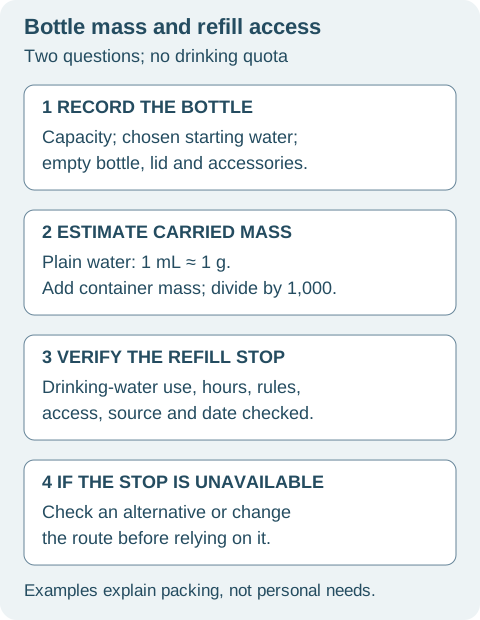
Keep three entries separate: capacity is the available volume; starting fill is the water you choose to put inside; empty mass is the bottle, lid and anything attached that you intend to carry. A partially filled large bottle may carry the same amount of water as a full smaller one, with a different empty mass and space in the bag.
This planner calculates approximate carried mass and unused capacity. It does not choose a personal drinking allowance. The NHS water and drinks guidance explains that food and other drinks contribute to fluid intake and that needs vary with circumstances, including heat and activity. Its cup-count guide is not a formula for filling everyone’s bottle.
Write the trip’s starting point, planned stops and return arrangements first. A city visit with confirmed drinking-water access and a remote walk have different supply questions even if the bottles look identical. Follow any personal fluid instructions you have; a packing calculation does not change them.
Estimate water mass and add the empty bottle
USGS describes water’s density as approximately 1 gram per milliliter. For this rough packing calculation, 1,000 mL of plain water adds about 1 kg. Density changes with temperature and dissolved substances, so the result is an estimate for carrying, not a laboratory measurement.
Starting carried mass, kg ≈ (starting water, mL + empty bottle, g) ÷ 1,000
Carried mass at stated full capacity, kg ≈ (capacity, mL + empty bottle, g) ÷ 1,000
Unused capacity, mL = capacity − starting fill
For an invented 1,000 mL bottle containing 750 mL, with a 250 g bottle and lid, the approximate starting mass is (750 + 250) ÷ 1,000 = 1.000 kg. At full capacity it would be about 1.250 kg. Its unused capacity is 250 mL. The three decimal places make the arithmetic visible; they do not establish that the bottle, marks or scale are accurate to that precision.
Weigh the empty bottle with its lid and accessories if you need a practical comparison. If you only have a manufacturer’s stated mass, record that basis and whether it includes the lid. A sleeve, strap or filter assembly can change the carried mass. Avoid adding an accessory twice if it is already included in the figure.
Ice, sweetened drinks and mixed ingredients make this plain-water approximation less suitable. To compare those loads, weighing the filled container directly can answer the carrying question without pretending the liquid has exactly the same density as water. The weight calculation also says nothing about the safety of a water source or bottle cleanliness.
Compare three fictional packing choices
| Choice | Capacity / fill / empty mass | Starting mass | Mass when full | Unused capacity |
|---|---|---|---|---|
| Small bottle, partly filled | 500 mL / 400 mL / 180 g | 0.580 kg | 0.680 kg | 100 mL |
| Large bottle, partly filled | 1,000 mL / 750 mL / 250 g | 1.000 kg | 1.250 kg | 250 mL |
| Empty bottle to fill later | 750 mL / 0 mL / 140 g | 0.140 kg | 0.890 kg | 750 mL |
These invented entries show how the same questions produce different packing results. They do not identify a recommended size, ideal starting fill, tested product or sufficient supply for a particular person.
If the first two bottles are packed together, their starting masses add to 0.580 + 1.000 = 1.580 kg, and their water contents total 1,150 mL. Together at full stated capacity they would weigh about 1.930 kg. Include both empty bottles; simply converting the water volume to kilograms would miss 430 g of container mass.
The empty-bottle case is useful when entry rules require an empty container, but it creates a separate access question: where can you obtain suitable drinking water before you need it? A zero starting fill is a valid arithmetic entry. It is not approval to begin a trip with no available water.
Try the arrangement in the bag you will actually use. Consider access to the lid, whether the bottle stays upright as required by its design, and whether the bag becomes awkward to carry. A number alone cannot assess your comfort, mobility needs or the consequences of a leak.
Verify refill stops instead of assuming a map icon is enough
Identify an actual drinking-water supply, not just any tap, stream or pool. Confirm what the venue says the facility is for. A map symbol may identify a feature without establishing current opening, availability or whether you may fill a bottle there.
For each stop, keep a source and checked date. Official visitor information or a direct staff answer is more useful than a photo that may be several years old. This guide has not checked a particular theme park, festival, station or city’s current rules; the blank record is where your trip-specific facts belong.
| Planned stop | Facts to establish | Evidence entry | If unavailable |
|---|---|---|---|
| Entrance or departure stop | Exact location, current bottle/bag rule, drinking-water access | Official page or staff answer and date checked | Fill before arrival elsewhere, if allowed and suitable |
| Midday stop | Opening hours, route detour, refill location and accessibility | Current venue information; unknown if not confirmed | Another confirmed stop or a changed route |
| Return or late stop | Whether access remains open after the event or attraction closes | Source and time checked; planned is not observed | Suitable supply or earlier departure arranged before relying on it |
Check whether a stop can be reached in the direction you are traveling, whether entering it needs a ticket, and whether a long queue or restricted re-entry changes the plan. A nearby station across a barrier is not automatically an available stop. For accessibility questions, seek the venue’s actual information rather than inferring suitability from distance alone.
NPS’s ten essentials guidance emphasizes planning supplies and checking the specific park before an outdoor trip. It also discusses water that may need appropriate treatment. That context does not turn an ordinary bottle, an unspecified filter or a natural water source into verified drinking water. This urban and venue-day planner is not a complete backcountry water or emergency plan.
Use the capacity and carrying-mass calculator
Enter one bottle’s known capacity, chosen starting fill and empty mass. Use mL and g, without commas or unit text. Decimal entries may have up to three places. An unknown empty mass is not zero; leave it unresolved until you have a figure you can use.
Capacity must be greater than zero. Starting fill and empty mass can be zero, but cannot be negative. Starting fill must fit the stated capacity. A blank, unsupported format or fill above capacity produces a correction message rather than a result.
The calculator uses the plain-water approximation above, shows the arithmetic and calculates unused capacity. “Unused” means room in the container, not water you are required to drink. It has no per-hour rate, body-weight formula, health score or remaining daily quota.
The fields stay in this page and are not stored or submitted by this calculator. Editing a figure clears the previous result so it cannot silently describe the old entries. The clear button leaves the record empty; it does not mean your packed bottle is empty. If you use several bottles, calculate each separately and add their masses for the packing total.
Make an unavailable-stop plan before departure
A planned refill is a dependency. If a station is closed, a venue changes a container rule or access takes much longer than expected, the plan needs another verified option. Adding an optimistic station to a spreadsheet does not create water access.
Consider the actual alternatives before the trip: fill from a suitable source earlier where permitted, choose a route with confirmed supplies, arrange an allowed purchase, shorten the outing or reconsider the destination. These are logistical possibilities to check, not a universal instruction to carry a particular number of liters.
A lighter starting load and an empty bottle shift reliance toward later access. A larger starting load reduces that dependency but increases what you carry. Neither arrangement is automatically better. Compare the trade-off using your confirmed stops, the people taking part, conditions and relevant instructions.
Keep drinking records separate from packing. Starting with 750 mL does not show that you drank 750 mL. For actual refills, contents left over and water shared or poured away, use the separate water-bottle refill measurement worksheet. Its contents-balance calculator answers a different question.
For a park visit, the theme park day checklist organizes entry rules, queues and refill detours. The festival day checklist organizes event rules, stages, access and re-entry. If someone feels unwell, attend to that need and seek appropriate help instead of trying to finish the arithmetic or stay in a queue.
Keep a short packing and refill record
View the original packing diagram, then open the editable day-trip bottle record. The text file also includes the invented mass examples and answer notes. It can be saved or copied using your browser’s usual file controls.
TRIP / DATE / PEOPLE AND ACTUAL REQUIREMENTS:
BOTTLE / CAPACITY mL / BASIS OF CAPACITY FIGURE:
EMPTY MASS g / LID AND ACCESSORIES INCLUDED / MEASURED OR STATED:
CHOSEN STARTING FILL mL / APPROXIMATE STARTING MASS kg:
APPROXIMATE MASS WHEN FULL kg / UNUSED CAPACITY mL:
STOP / LOCATION / HOURS / ACCESS / CONFIRMED DRINKING-WATER USE:
SOURCE / DATE CHECKED / FACTS STILL UNKNOWN:
ALLOWED CONTAINER / BAG / ENTRY AND RE-ENTRY RULE:
IF THAT STOP IS UNAVAILABLE / ALTERNATIVE TO VERIFY:
WHAT WAS ACTUALLY AVAILABLE ON THE DAY / CHANGE MADE:
“Official map checked yesterday; opening hours not confirmed” is a useful incomplete entry. Do not turn that into “guaranteed refill” to make the record look finished. When the trip happens, record what was actually available if it affects a later plan.
Keep only information relevant to packing and access. No medical history, account or location submission is required to use this page. A saved personal itinerary remains a file you manage; consider where you keep or share it.
Eight checks before relying on a bottle plan
Try these fictional cases before opening the answers. They test units, container mass and access assumptions, not hydration status.
Case 1
A bottle has 1,000 mL capacity, 750 mL starting water and 250 g empty mass. What are its three results?
Show answer and explanation for case 1
About 1.000 kg starting; 1.250 kg full; 250 mL unused capacity.
Add container mass to water mass, then divide by 1,000. Capacity minus actual fill gives room left, not a drinking quota.
Case 2
A 500 mL bottle starts with 400 mL and weighs 180 g empty. Is 0.400 kg the whole packed mass?
Show answer and explanation for case 2
No. The starting carried mass is about 0.580 kg.
The water contributes about 400 g and the container contributes 180 g. Counting only water omits the bottle and included lid.
Case 3
A 750 mL bottle has zero starting water and 140 g empty mass. Does a valid result prove the trip supply is adequate?
Show answer and explanation for case 3
No. The mass is about 0.140 kg, but access remains a separate question.
Zero is a legitimate known fill amount. The calculation cannot establish suitable supply, later station availability or personal requirements.
Case 4
The empty mass is unknown. Should you enter zero to get a result?
Show answer and explanation for case 4
No. Obtain or identify a usable mass figure first.
Zero asserts no container mass. A blank unknown must not silently become zero; note whether the figure is measured or stated.
Case 5
Starting fill is entered as 800 mL for a 500 mL bottle. What should happen?
Show answer and explanation for case 5
The calculator rejects the entry.
One bottle’s starting contents must fit its stated capacity. Do not clamp 800 to 500 or reinterpret it as several refill events.
Case 6
The fictional 500 mL and 1,000 mL bottles above are packed together. What is the starting mass?
Show answer and explanation for case 6
About 1.580 kg.
Add 0.580 and 1.000 kg, including both containers. The total 1,150 mL of starting water alone is not the complete mass.
Case 7
A map shows a tap near the event, but drinking-water use and opening hours are unknown. Is the refill confirmed?
Show answer and explanation for case 7
No. Keep the missing facts visible and verify an alternative.
Proximity and a map icon do not establish suitable drinking water or usable access on the day.
Case 8
Unused capacity is 250 mL. Is that an instruction to drink another 250 mL?
Show answer and explanation for case 8
No. It describes space in this bottle.
Packing capacity, drinking history and personal fluid needs are different questions. The planner does not supply a health target.
Sources and further reading
- USGS: Water Density (24 August 2026)Approximately 1 g/mL for water; temperature and dissolved material affect density. The tool uses a rounded packing approximation, not precise physical-property values.
- NHS: Water, drinks and hydration (reviewed 17 May 2023)Foods and other drinks contribute to fluid intake and requirements vary. Its general cup-count guidance is not converted into a fixed bottle target.
- NPS: Ten Essentials (updated 28 May 2026)Outdoor trip preparation, destination-specific planning and suitable supplies. This day-trip planner is not a complete backcountry water or treatment plan.