Practical guide
How to Verify a Water Filter Model in the NSF Database
Copy the manufacturer, full system model and replacement element. Use the right NSF search form, read the exact standard and named claim, follow the item’s scope and footnotes, and save the confirmed URL with dates. A matching brand, material-only component or standard number alone cannot establish every contaminant claim.
Start with the exact product, not the logo
To verify a water filter in the NSF database, identify the manufacturer, whole-system model and replacement element, then match the exact reduction claim and its conditions. A familiar brand or a standard number alone cannot finish the check.
This guide walks through two searches actually performed in NSF’s public drinking-water treatment-unit database: a manufacturer search for Brita and a model search for OB06. The resulting examples show why a replacement cartridge, a complete system and a component-only listing need different interpretations. They are records to read, not product recommendations.
Before searching, copy the identifiers from your own label, packaging or manufacturer instructions. Preserve suffixes, punctuation and the distinction between the housing model and cartridge code. A retailer’s shortened name can omit the part that distinguishes one certified combination from another.
Name the concern separately: chlorine taste, lead, a particular PFAS claim or another specified substance. CDC advises choosing treatment for the substances of concern, using water evidence rather than taste or appearance. This lookup does not test your water or decide whether a filter is needed.
If an official advisory or a household health concern requires a particular response, follow the relevant current instructions and qualified advice. A routine certification check cannot establish that an installed device is suitable for every unsafe-water situation.
Prepare five fields before opening the search
Keep the product evidence beside the database result. If you have only a shop listing or an indistinct logo, mark the missing information rather than supplying a likely model from memory.
| Field | What to capture | Common mismatch |
|---|---|---|
| Manufacturer | Name on the device or official documentation. | A trade name and legal listing name can differ. |
| Whole-system model | Complete model including its suffix. | A cartridge code is not automatically a system model. |
| Replacement element | Exact cartridge or element required for that system. | Physical fit alone does not establish a listed combination. |
| Concern / claim | The actual substance or taste issue being checked. | A broad standard number does not name every claim. |
| Certifier named | Organization stated in the certification wording. | This guide checks NSF’s own database, not every certifier’s directory. |
Do not combine the manufacturer box and model box as if they were one search form. On the page examined, Manufacturer has its own “Search by Manufacturer” button. “Brand Name / Trade Name / Model” appears in a separate form with a Product Standard dropdown and its own Search button.
When a package names another certification organization, use that organization’s official directory or ask it to clarify the record. Not finding a product in this NSF directory alone is not proof that no certification exists anywhere. Conversely, vague wording such as “tested to” does not identify a current listing in the directory you are checking.
Use the manufacturer and model searches deliberately
Open the NSF drinking-water treatment-unit search. The manufacturer field instructs you to enter at least three letters. In the first worked search, Brita was entered there and “Search by Manufacturer” was clicked. That produced a broad result containing different product types and standards.
For a known model, use “Brand Name / Trade Name / Model.” In the second search, OB06 was entered and Product Standard was left at All Product Standards. The Search button in that form returned three matching product rows under NSF/ANSI 53. A match in this field can appear within a full model string; the result still needs to be read row by row.
You may choose a particular standard when it fits the question, but a restrictive filter can hide other records. Record the query and selected standard so that a later reader understands what the search actually covered. Do not describe a narrowly filtered result as a complete inventory of a brand’s certifications.
The separate Reduction Claim search also has an important control: the page explains that selected claims normally return products certified for ANY of them. It offers a checkbox for ALL selected claims. We inspected those controls but did not submit a claim search for these examples.
If you select lead and another concern in an ANY search, a returned product may satisfy only one. Inspect its actual claim list. Even an ALL result does not remove the need to check the exact model, replacement element and footnotes.
On the result pages used here, NSF supplies an alert and a confirmation link for the most accurate listing information. We clicked that link in both searches. Open the official confirmation link when shown rather than treating a copied shop screenshot as the live record.
Worked example: Tidal and the OB06 replacement element
The verified model-search result lists “Tidal - Model #OB63/OB06” with replacement element OB06, service cycle 120 gallons, flow rate N/A and Lead Reduction under NSF/ANSI 53. One facility entry is in the Dominican Republic; another Canadian facility entry lists this Tidal combination and “Pacifica - Model#OB41/OB06.”
| Listing field | Observed record | Limit of that observation |
|---|---|---|
| Standard / company | NSF/ANSI 53; The Brita Products Company. | Do not apply a different company’s component record to this row. |
| System model | Tidal - Model #OB63/OB06. | Read the full string, including both model parts. |
| Replacement element | OB06. | This does not certify every housing that accepts OB06. |
| Service cycle / flow | 120 gallons; flow rate N/A. | Capacity is not a calendar replacement interval; N/A is not zero flow. |
| Claim | Lead Reduction. | No additional contaminant claim follows merely from the standard number. |
The three matching product rows are not three interchangeable cartridges. Nor does the result establish that every product sold under the same brand has lead reduction. Compare your actual system and element with the row, using the required installation and maintenance instructions for that product.
The Canadian facility’s Pour Through heading carries a [G] footnote stating certification to NSF/ANSI/CAN 372 and compliance with lead-content requirements for “lead free” plumbing. That concerns lead in the product’s materials. The Lead Reduction claim in the NSF/ANSI 53 row is the separate evidence relevant to reduction from water.
Do not convert 120 gallons into an invented number of months or a guaranteed period of household protection. The table shows a rated service cycle, not your usage, source-water conditions or the manufacturer’s full replacement instructions. “N/A” in the flow column must remain N/A in your record.
We did not inspect a physical Tidal package or perform a water test. This is a demonstration of reading the official listing. Its claim cannot certify your installed cartridge’s condition or establish a particular concentration in water leaving your tap.
Worked contrast: a component and material-only footnote
The broader manufacturer search shows “Intenza [3][Pb]” in an NSF/ANSI 42 section headed COMPONENTS: Filter Cartridges. Its [3] note says “Conforms to material requirements only.” The record therefore cannot be turned into a contaminant-reduction promise for that component.
| Item or marker | What to read | What not to infer |
|---|---|---|
| Intenza [3][Pb], in an NSF/ANSI 42 component section | [3] says it conforms to material requirements only. | Do not invent chlorine, lead or any other reduction claim for this row. |
| [Pb] footnote | Lead-content requirements for lead-free plumbing. | Lead content in a component differs from reducing lead in water. |
| CLARITY Protect 100 [4][5][6], a nearby component | Its own numbered notes describe scope and test conditions. | Those notes do not transfer to Intenza just because it is nearby. |
| A standard heading without a named reduction claim | Identifies the relevant standard or listing section. | It is not a list of every possible contaminant that the item reduces. |
A nearby CLARITY Protect 100 entry has different markers: [4], [5] and [6]. One note names material and structural requirements, another lists particular testing conditions and claims, and another limits the intended dispensers. The lesson is to follow the markers attached to the exact item rather than borrow a more attractive note from another row.
NSF’s standards explanation states that standard numbers reflect the order of development, not a ranking. Standard 42 concerns aesthetic effects; 53 concerns health-effect contaminants; 58 covers reverse-osmosis systems. Certification does not mean reduction of all contaminants within or beyond a category.
For a complete list of applicable claims, use the exact current product record and relevant performance documentation. Do not infer that a material-only component is a certified complete treatment system, or that a larger standard number describes a stronger filter.
The filter-label wording guide explains how to separate a logo, a named certification, a standard and a specific claim before you search. The certification decision guide starts from the concern the treatment is supposed to address.
Save a dated record and keep unknowns visible
The examined listings state that they are current as of Saturday, October 31, 2026 at 12:15 a.m. Eastern Time. That is the listing’s own displayed currency statement, not a claim that this article or a screenshot refreshes continuously. Our searches were checked on 31 October 2026 UTC. Reopen the official record when making a later decision.
Save both your check time and the listing’s displayed currency information. NSF asks readers to contact it to confirm a listing’s status or report errors. A saved worksheet documents what you read; it does not replace that confirmation or permanently establish a status.
WATER FILTER LISTING CHECK - ONE PRODUCT / ONE CONCERN
Date and time I checked:
Product evidence used (label / instructions / other):
Manufacturer and certifier named:
Whole-system model, including suffix:
Replacement element required:
Search field / query / selected standard:
Official confirmed listing URL:
Listing's stated currency date/time:
Standard and exact reduction claim:
Component or complete-system scope / footnotes:
Rated service cycle and flow, preserving units or N/A:
Instructions still to check / unresolved mismatch / next question:
If a search has no exact match, check the code from official product evidence and the certifier named. A spelling error, a trade-name difference, restrictive search choices or a different certification organization may need clarification. Leave the result as unresolved until the specific record is established. Do not replace a missing model with a similar-looking one.
CDC also stresses maintaining filters according to the manufacturer’s recommendations. A matching listing and a correctly maintained installed product are different checks. Keep replacement, installation and any source-water conditions with the actual instructions; the directory alone cannot show how your device has been used.
For source-water evidence, the tap-water guide points to the separate question of reports and local conditions. Product certification answers a narrower product-performance question. It does not make your source-water evidence unnecessary.
Use the original checklist beside the official result
The card below organizes this guide’s checking sequence. It is an original educational diagram, not an NSF certificate, seal or reproduction of a manufacturer’s label. Read the listing and its footnotes alongside it.
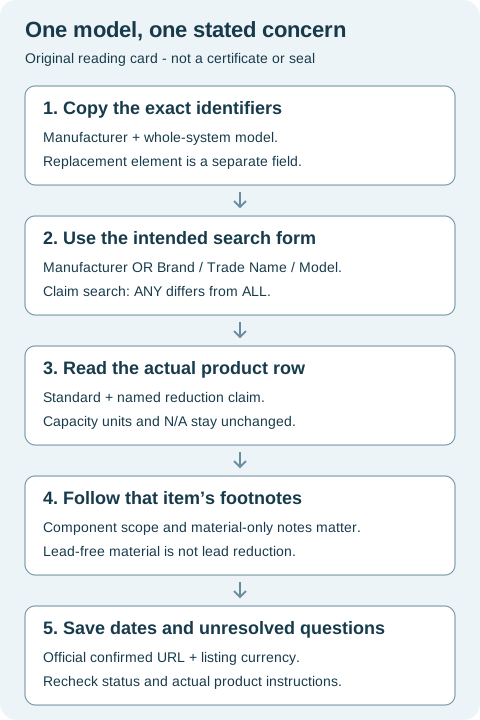
Download the model, claim and date worksheet for a plain-text record. Copy the observed units and any N/A value without guessing. An empty field is useful when it identifies the question you still need answered.
Use the sheet again when a replacement element, product model, instruction or relevant record changes. The useful outcome is a traceable match, or an explicit unresolved question. It is not a product ranking or a promise about your water.
Six checks before treating a search result as proof
Try these fictional interpretation questions and open the explanations. They use the observed examples but do not evaluate a real installed filter or measure anyone’s water quality.
Case 1
A result shows Tidal - Model #OB63/OB06 and OB06 in the replacement column. Is OB06 alone the full system model?
Show answer and explanation for case 1
No. Record the full system string and the separate replacement element.
A cartridge number can appear in a system name; it does not establish every possible housing combination.
Case 2
A row is under NSF/ANSI 53 and names Lead Reduction. May you add every other health-effect contaminant?
Show answer and explanation for case 2
No. Keep the exact named claim.
A standard covers a category; the product’s record identifies its certified claims.
Case 3
Intenza has [3] stating material requirements only. Does the nearby standard heading prove lead reduction?
Show answer and explanation for case 3
No. The row and its footnote do not supply that reduction claim.
Material scope and the [Pb] lead-content note must not be converted into removal of lead from water.
Case 4
An ANY claim search returns a product after two concerns were selected. Does it necessarily meet both?
Show answer and explanation for case 4
No. Read the product’s actual claims or deliberately use the ALL option when appropriate.
The default ANY setting can match one of the selected claims; every result still needs exact-model review.
Case 5
A service cycle is 120 gallons and flow is N/A. Can the record say six months at a specified flow?
Show answer and explanation for case 5
No. Preserve the capacity unit and N/A.
The listing does not supply a personal calendar replacement interval or a numeric flow value in that cell.
Case 6
Your model is absent from this NSF search. Is it proven uncertified by every organization?
Show answer and explanation for case 6
No. Mark the NSF result unresolved and check the certifier and exact identifiers.
This guide examines NSF’s directory. Another organization’s record, a query mismatch or a trade-name issue requires its own verification.
Sources and further reading
- NSF: Drinking-water treatment-unit searchManufacturer and model search fields, standard filters and the ANY/ALL options for reduction-claim searches.
- NSF: Confirmed Brita manufacturer listingManufacturer listing used for the Intenza material-only component example and item-specific footnotes; displayed currency 31 October 2026 at 12:15 a.m. Eastern Time.
- NSF: Standards for Water Treatment SystemsStandard categories, the meaning of standard numbers and the limits of contaminant certification.
- CDC: About Choosing Home Water Filters (10 April 2024)Choosing treatment for the actual concern, using water evidence and maintaining filters according to manufacturer recommendations.
- NSF: Confirmed OB06 model-search listingModel listing used for the Tidal system/OB06 element example, rated 120-gallon service cycle, N/A flow and Lead Reduction; displayed currency 31 October 2026 at 12:15 a.m. Eastern Time.
When the evidence is a laboratory report
For a report result, read ND, the reporting limit, units and sample together. For a bottled-water claim, check what the test report establishes and what separate certification evidence is needed. The treatment-unit directory used in this filter guide is a different product category.