calculators
Hydration Checklist
Hydration Checklist is useful only when it outputs a range and shows when not to personalize the result. Risk flags matter as much as the number. Pick a situation and use the short checklist as a daily cue. This Hydration Checklist page provides general education for generally healthy people and is not medical advice, diagnosis, treatment, prevention, or a personalized fluid prescription; Symptoms, infants, older adults, and chronic disease are outside a checklist's authority.
This Hydration Checklist page provides general education for generally healthy people and is not medical advice, diagnosis, treatment, prevention, or a personalized fluid prescription; Symptoms, infants, older adults, and chronic disease are outside a checklist's authority.
Daily Water Range
Water Type Comparison
Tap
Daily convenience when the local report and home plumbing are acceptable.
Consumer Confidence Report, local alerts, and older plumbing risk.Filtered
A specific taste or contaminant concern when the filter is certified for that concern.
Certification label, replacement schedule, and the contaminant it actually reduces.Seasonal Planner
- Carry water before thirst becomes the only cue.
- Add shade breaks and cooling time.
- Treat confusion, fainting, or heat illness signs as urgent.
Urine Color Cue
Checklist And Reminder Plan
Choose a situation, keep the plan local, and print it when useful.
Everyday checklist
- Keep water visible during the first half of the day.
- Use meals as refill cues instead of chasing a fixed number.
- Pause when thirst, urine color, heat, or activity tells a different story.
- Use safety pages when symptoms or fluid limits enter the picture.
Steady day rhythm
Simple 7-day check follow-up
Saved plans stay in this browser only.
Filter Proof Checklist
Match the concern to proof before a product decision.
This checklist is evidence routing only. It does not recommend a brand, collect data, or prove a home water source is safe.
What To Do First
Pick a situation and use the short checklist as a daily cue.
When This Page Helps
A reader wants a non-numeric habit tool.
A printable-style hydration checklist.
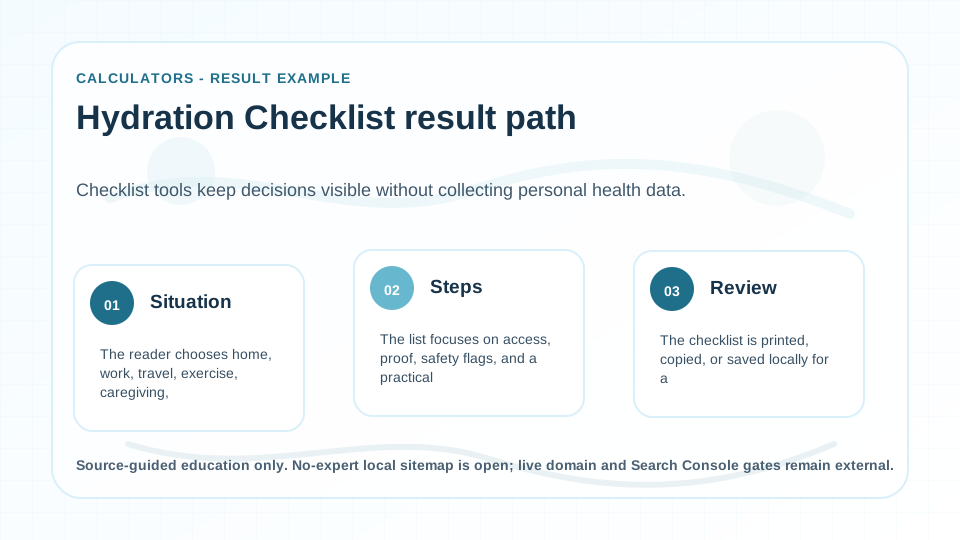
Hydration Checklist result path
Checklist tools keep decisions visible without collecting personal health data.
The reader chooses home, work, travel, exercise, caregiving, or water-quality context.
The list focuses on access, proof, safety flags, and a practical next move.
The checklist is printed, copied, or saved locally for a simple follow-up.
Use Hydration Checklist as a range, not a rule
Guidance from Centers for Disease Control and Prevention and Cleveland Clinic frames this page as practical education for a specific reader task, not as a universal drinking rule or medical instruction. A calculator page is strongest when it shows uncertainty and makes stop flags easier to notice.
Hydration Checklist is best for readers who want a practical estimate while still respecting symptoms, conditions, and context.
The common mistake is treating the output as a prescription, then forcing the number even when the day or body disagrees.
Pick a situation and use the short checklist as a daily cue. Spread the result across ordinary cues such as meals, breaks, workouts, and evening comfort.
Stop personalizing the result when fluid restriction, pregnancy, infant care, kidney, heart, liver, sodium, or severe symptoms apply.
Before You Use This Page
- Name the real situation before applying Hydration Checklist; the page is strongest when the reader has a concrete task.
- Use the next action first: Pick a situation and use the short checklist as a daily cue.
- Check the exception line before making the advice personal: Symptoms, infants, older adults, and chronic disease are outside a checklist's authority.
- Confirm the source context with Centers for Disease Control and Prevention before treating this as more than general education.
- Treat the result as a range and spread it across normal meals, breaks, workouts, and evening comfort.
- Stop personalizing the result when the inputs hide symptoms, medical instructions, or fluid-restriction concerns.
Hydration question prep
Hydration Checklist for Ordinary Routine Review
Use a short checklist to spot access and timing issues without turning water into a prescription.
| Question | Record or compare | Keep outside the page |
|---|---|---|
| Context | Ordinary setting, heat, activity, access, and recent routine | A diagnosis or personal requirement |
| Existing instruction | Clinician fluid, sodium, medicine, kidney, heart, or pregnancy guidance | Changing a care plan from a website |
| Observable change | Plain words, timing, and functional effect | Deciding cause or urgency |
| Source role | Which public source explains a general concept | A personal fluid or electrolyte prescription |
| Next question | What to ask a clinician, pharmacist, coach, or caregiver | A self-directed correction plan |
Before you use it
- Keep clinician-set fluid limits unchanged unless the clinician changes them.
- Record timeline and context rather than trying to label the problem.
- Use local urgent or emergency services for severe or fast-changing concerns; this page does not judge urgency.
Safety boundary: This page supports general hydration education and question preparation. It does not diagnose dehydration or low sodium, prescribe fluid or electrolyte intake, override care instructions, or triage an individual.
FAQ
Is hydration checklist medical advice?
Hydration Checklist is general education, not professional medical advice. It should not replace diagnosis, treatment, prevention, a clinician's instructions, or urgent care when symptoms are serious.
What should I check first for hydration checklist?
Pick a situation and use the short checklist as a daily cue. For hydration checklist, the first check should match the actual task rather than defaulting to more water.
Who should be more cautious with hydration checklist?
Symptoms, infants, older adults, and chronic disease are outside a checklist's authority. That means hydration checklist should be treated differently when symptoms, medical conditions, medications, pregnancy, infant care, older adult care, heat illness, or fluid restriction are involved.
What makes hydration checklist different from a general hydration rule?
Hydration Checklist is only useful when the output remains a range and risk flags stop the calculator from sounding more certain than it is.
Evidence limit for Hydration Checklist
Centers for Disease Control and Prevention and Cleveland Clinic support the general framing, but they do not verify an individual reader's health condition, home plumbing, product batch, race plan, or clinician instruction. Stop before turning this page into a personal fluid target. Symptoms, infants, older adults, and chronic disease are outside a checklist's authority.
- Hydration Checklist is useful only when the output remains a range and stop flags are visible.
- Weight, activity, heat, duration, timing, and special conditions should change or stop personalization.
- The result must not override symptoms, medical advice, fluid restriction, infant care, pregnancy guidance, or endurance safety.
- Centers for Disease Control and Prevention anchors this section for Plain-water and lower-sugar drink framing for general public health education.
Use Hydration Checklist as a range
A reader wants a non-numeric habit tool. A calculator is helpful only when it shows uncertainty and makes risk flags visible.
- Hydration Checklist is useful only when the output remains a range and stop flags are visible.
- Weight, activity, heat, duration, timing, and special conditions should change or stop personalization.
- The result must not override symptoms, medical advice, fluid restriction, infant care, pregnancy guidance, or endurance safety.
- Cleveland Clinic anchors this section for Dehydration symptom education, risk-factor context, and when-to-seek-care framing.
Inputs that matter for Hydration Checklist
Pick a situation and use the short checklist as a daily cue. Weight, activity, heat, duration, and special conditions should change the output or stop personalization.
- Hydration Checklist is useful only when the output remains a range and stop flags are visible.
- Weight, activity, heat, duration, timing, and special conditions should change or stop personalization.
- The result must not override symptoms, medical advice, fluid restriction, infant care, pregnancy guidance, or endurance safety.
- Centers for Disease Control and Prevention anchors this section for Plain-water and lower-sugar drink framing for general public health education.
What the result should not do
The output should not override fluid restriction, medical advice, symptoms, pregnancy guidance, infant care, or endurance-event safety.
- Hydration Checklist is useful only when the output remains a range and stop flags are visible.
- Weight, activity, heat, duration, timing, and special conditions should change or stop personalization.
- The result must not override symptoms, medical advice, fluid restriction, infant care, pregnancy guidance, or endurance safety.
- Cleveland Clinic anchors this section for Dehydration symptom education, risk-factor context, and when-to-seek-care framing.