Practical guide
CamelBak Drinking Tube Freezing: Protect the Flow Path and Carry a Backup
Plan the reservoir, tube and bite valve as one flow path. CamelBak’s written cold-weather guidance uses warm but not boiling water, body-side routing and clearing retained tube water; it also says freezing can still occur. Match any insulated accessory to the actual system and carry a usable wider-mouth backup. These equipment steps do not set how much or how often to drink.
On this page
Start with the component that can block access
A full reservoir does not guarantee that water will reach its drinking valve in freezing weather. CamelBak identifies the narrow tube and bite valve as parts that can freeze early. The planning problem is access through the whole system, not merely how much water fits in the main container.
Name your reservoir, tube, valve and pack arrangement before adding an accessory. Follow the instructions for those versions. A thermal kit or replacement hose for one connector does not establish a match for an unidentified reservoir.
The manufacturer also says that water can freeze anyway in extremely cold conditions. Use that stated limit when planning the backup rather than treating a product name as a guarantee of operation.
Source: [1].
Prepare the reservoir and the body-side route
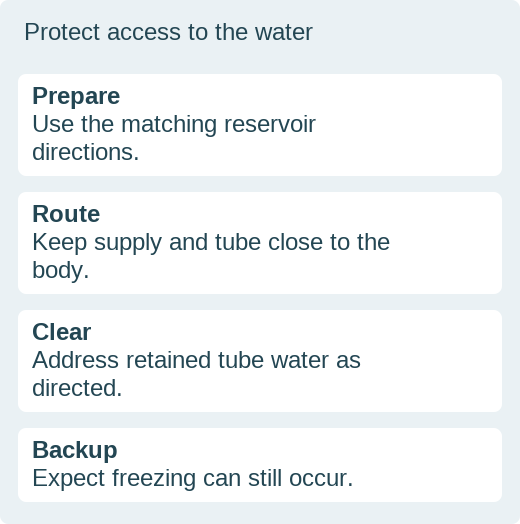
The written manufacturer guidance recommends filling with warm, but not boiling, water. Keep that temperature distinction intact. This page supplies no numerical temperature limit or warming method for a different reservoir or drinking tube.
CamelBak recommends keeping the water supply close to the body by wearing the pack under a jacket and routing the drinking tube under the arm or through a pit zip. Use a workable arrangement for the actual pack and clothing rather than leaving the tube exposed while protecting only the main reservoir.
Check that the complete setup lets you use the drinking path as intended. If a clothing or packing change interferes with access, fix the arrangement before depending on it. Body-side routing is an equipment setup, not proof that the system will remain unfrozen for a measured duration.
Source: [1].
Address water retained in the tube as the model directs
The CamelBak FAQ describes blowing back into the drinking tube after a sip to clear water from its narrower sections, including the valve and tube. Use that technique only within the directions for the matching system. It is not a universal instruction for every bottle straw, connector or shared drinking arrangement.
Clearing retained water is an equipment operation. Choose drinking frequency and amount from your actual needs and appropriate guidance; an accessory workflow does not supply an intake target. Keep the flow-path check separate from how much water you plan to drink.
If the path is already blocked, use the applicable equipment instructions and the functioning backup rather than counting the inaccessible reservoir as an available drink. This source does not provide a universal thawing temperature, a pressure procedure or a repair method for a damaged frozen part.
Source: [1].
Read an insulated accessory as a scoped product option
On a phone, scroll inside this table. Keyboard users can focus it and use arrow keys.
| Question | Useful evidence | What remains open |
|---|---|---|
| Does the thermal hose fit? | The actual connector and compatible system stated by its instructions. | A similar tube diameter or a shared brand is not compatibility evidence. |
| What does “Freeze-Proof Valve” mean here? | The manufacturer names it in a Crux Thermal Control kit example. | The same FAQ still says the water may freeze in extreme cold. |
| Is a backup usable? | A suitable wider-mouth bottle with its own correct closure and instructions. | An extra container is not a guaranteed supply if its contents are inaccessible too. |
The written FAQ describes a Crux Quicklink thermal-kit example. Confirm the actual system, connector and compatible kit instructions before choosing or changing parts. That named example does not identify a replacement for every reservoir.
The FAQ suggests a wider-mouth backup, giving Chute as an example. Treat the role as a usable alternate container. Do not transfer another brand’s freezer, cleaning or drink-permission rule to it.
Source: [1].
Compare three cold-weather arrangements
These fictional cases apply the written equipment guidance. No reservoir or accessory was tested for this article.
Case 1
The reservoir is full and inside a jacket, but its unprotected valve and tube no longer deliver water. Is full capacity enough to count it as an accessible supply?
Show answer and explanation for case 1
No. The flow path has a problem; use the functioning backup and the actual equipment guidance.
The narrow drinking components can block access even while water remains in the main container. Capacity and current accessibility are different facts.
Case 2
A thermal-kit description contains the name “Freeze-Proof Valve.” Can the owner remove the backup from the plan on that name alone?
Show answer and explanation for case 2
No. Keep the actual compatibility and the manufacturer’s stated freezing limit in view, and retain a usable backup.
The same source says that water may still freeze in extreme conditions. The accessory name does not provide a tested temperature or duration guarantee for this setup.
Case 3
The owner uses boiling water because it seems likely to stay warm longer than warm water. Does that follow the cited preparation step?
Show answer and explanation for case 3
No. The written step specifically says warm, but not boiling, water.
A guessed performance improvement does not change the source’s temperature distinction or establish what an actual reservoir and tube can accept.
Record the setup you will actually depend on
Keep a short equipment record: reservoir and valve model, tube route, permitted preparation step, accessory compatibility still to confirm, and the alternate container you can actually use. Check the complete system using its own directions before depending on it.
If the relevant concern is washing or a mechanical leak, use the ordinary parts-care guide or the reservoir-cap workflow. A clean cap does not answer a freezing question, and a winter accessory does not resolve damaged threads or a torn ring.
This guide addresses drinking equipment. Individual fluid needs, symptoms, weather exposure and route decisions require their own appropriate guidance; a working tube does not establish a suitable intake target or a safe outing.
Source: [1].
Sources and further reading
- CamelBak: Care & CleaningWritten manufacturer FAQ examples for the named design and task. Checked November 11, 2026. Match the instructions included with the version you own; no physical testing or repair validation is claimed.