Practical guide
Can You Put a Stanley Bottle in the Freezer? Pre-Cool It Instead
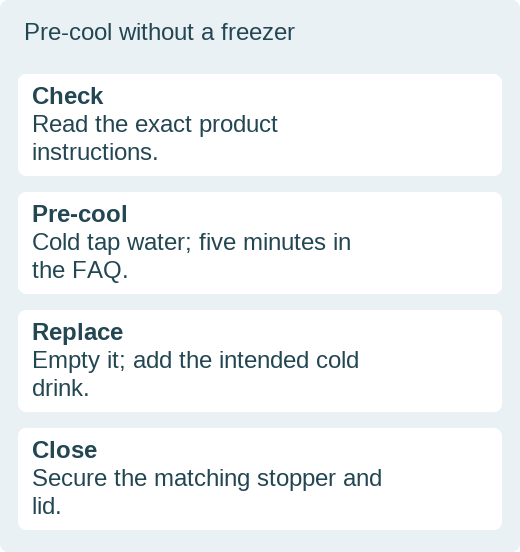
The checked Stanley FAQ says its products are not freezer-safe because expanding liquids can damage them. To pre-cool, its method uses cold tap water for five minutes, empties that water, then immediately fills the container and secures its stopper and lid. Keep the exact product instructions attached to the process; a loose lid or a short freezer visit does not supply an exception.
On this page
The manufacturer answer is no
Stanley’s current FAQ explicitly says its products are not freezer-safe and explains that expanding liquids can damage the product. If your aim is a colder drink, start with the permitted pre-cooling method instead of choosing a freezer duration.
The FAQ does not supply an exception for leaving the lid loose, freezing only part of the contents or making a short freezer visit. Those are different proposed arrangements, not documented permission. Read the instructions supplied with the exact product if its version or allowed use is unclear.
This is a report of the manufacturer’s restriction, not a freeze-damage experiment. No freezer temperature, exposure time or damage threshold was measured for this article.
Source: [1].
Separate pre-cooling the container from freezing its contents
Pre-cooling prepares the container with cold water before the intended cold drink goes in. In Stanley’s written method, the preparation water is emptied. It is not an instruction to freeze water inside the insulated product or to keep the preparation fill as a measured part of a drinking record.
The manufacturer gives a five-minute standing step and directs prompt refilling and closure. That timing describes the method in the FAQ. It does not guarantee a particular final temperature or establish how many hours your product will keep a drink cold.
Keep the container model and its drink/closure instructions attached to the task. A vacuum-insulated construction, a particular color or another owner’s routine cannot replace the manufacturer’s actual use restrictions.
Source: [1].
Follow the written cold-tap-water method
- Check the exact Stanley product instructions and prepare its matching stopper and lid.
- Fill the container with cold tap water for the pre-cooling step described in the FAQ. Use water suitable for the container and its intended drinking use.
- Let that preparation fill stand for five minutes, as the manufacturer specifies.
- Empty the pre-cooling water, then immediately fill with the intended cold beverage permitted by the product instructions.
- Secure the matching stopper and lid promptly, following the product’s own closing method.
The same source also describes preheating with warm tap water, but the steps above are the cold-drink route. Do not turn that separate example into permission to use boiling water, an unidentified drink or a closure whose instructions do not match.
If you are keeping a water-use record, distinguish the preparation fill that was emptied from the drink actually added afterwards. The bottle-refill worksheet explains additions, leftovers and non-drinking losses without setting an intake target.
Source: [1].
Keep appliance permissions separate
On a phone, scroll inside this table. Keyboard users can focus it and use arrow keys.
| Proposed method | Checked Stanley FAQ | Useful next step |
|---|---|---|
| Place the product in a freezer | Not freezer-safe; expanding liquids can damage the product. | Use the documented pre-cooling method and exact model instructions. |
| Put the product in a microwave | Not microwave-safe; the FAQ says product and appliance damage can result. | Use only a preparation method permitted for the actual item. |
| Use a dishwasher to wash it | Check the bottom for dishwasher-safe permission; the FAQ specifies the top rack if approved. | Treat cleaning permission separately from freezer or microwave permission. |
Dishwasher approval does not establish freezer or microwave approval. Each question refers to a different use condition. This table preserves the source’s separate answers rather than treating “can withstand heat” or “is insulated” as a general appliance rating.
The existing bottle-care page helps with ordinary parts washing. It is not a source of freezer permission for every brand, and this Stanley FAQ is not a freezer rule for an unidentified plastic bottle.
Source: [1].
Check three cooling decisions
These are fictional reading examples. They are not observations of products put in a freezer.
Case 1
An owner plans to leave a Stanley bottle lid loose in the freezer so the liquid can expand. Does that provide a manufacturer-approved exception?
Show answer and explanation for case 1
No. The cited FAQ does not provide that exception; use the permitted method and the exact product instructions.
An explanation of expansion does not turn a guessed workaround into a documented freezer approval.
Case 2
The owner pre-cools with cold tap water for five minutes, empties it and refills promptly. Can this article promise a particular number of cold-retention hours?
Show answer and explanation for case 2
No. The owner has followed the stated preparation route, but this article supplies no measured retention result for the product.
A method and a performance guarantee are different claims. The FAQ timing is not a test of the owner’s container, contents or conditions.
Case 3
A different-brand bottle looks similar to a Stanley bottle. Do the Stanley freezer and pre-cooling statements automatically apply?
Show answer and explanation for case 3
No. Find that bottle’s actual manufacturer and model instructions.
The checked source has a brand and task scope. Similar appearance does not identify a matching material, closure or use restriction.
Keep the actual method and remaining question clear
Write down the product identity, the instructions used, the preparation method and anything still unclear about the closure or intended drink. “Cold tap water stood for five minutes, then was emptied before the drink was added” is a useful process description. “It must be cold enough because it is insulated” leaves the actual method unspecified.
If the product has already been used contrary to its directions and its condition is uncertain, obtain model-specific manufacturer advice before relying on it. This article does not assess damage or validate an improvised repair. Its usable result is a documented permitted preparation route, not a claim about an unexamined container.
Source: [1].
Sources and further reading
- Stanley 1913: Frequently Asked QuestionsWritten manufacturer FAQ examples for the named design and task. Checked November 11, 2026. Match the instructions included with the version you own; no physical testing or repair validation is claimed.